For most students, attending university is something they rarely question. They walk into a classroom, meet classmates in the corridor, ask questions after a lecture and participate in campus life almost without thinking about it.
But for some students, simply being physically present is not always possible.
Health conditions, temporary hospitalization, disabilities, recovery from surgery or other personal circumstances may prevent students from attending campus for weeks or even months. While universities increasingly offer digital learning resources, physical absence often means much more than missing a lecture: it can lead to social isolation, reduced participation and, ultimately, a greater risk of academic disengagement.
Beyond online classes
The rapid adoption of videoconferencing tools, specially since the COVID-19 crisis, has transformed higher education. Online classes make it possible to follow lectures remotely and maintain contact with teachers.
However, attending a lecture through a laptop screen is not the same as being present on campus.
Traditional videoconferencing is designed primarily for communication. It allows students to see and hear what happens in the classroom, but it offers little autonomy or interaction with the surrounding environment. Remote students remain passive participants, unable to move around, join informal conversations, or experience the social dimension of university life.
Yet these informal interactions – meeting classmates before class, asking the teacher a question while leaving the room, working together between lectures – are often just as important as the lecture itself. They contribute to students’ sense of belonging and play a key role in motivation, engagement and academic success.
Telepresence: restoring presence, not just communication
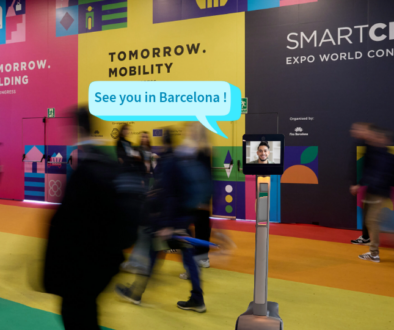
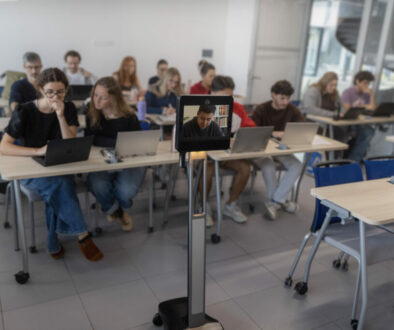
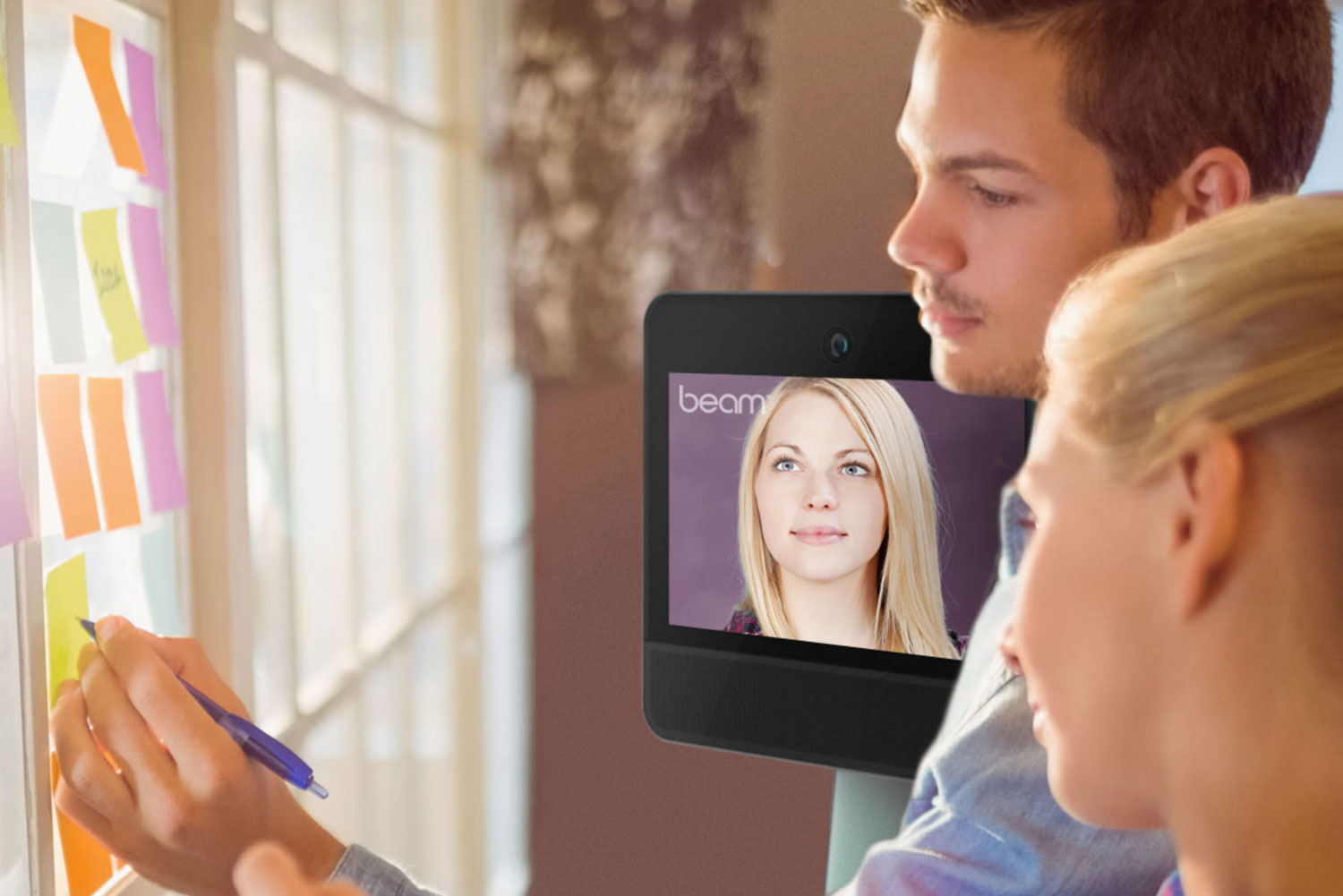
Telepresence offers a different approach. Using a remotely controlled mobile robot equipped with a screen, camera, microphone and speakers, students can move around the campus as if they were physically there. They can attend lectures, interact naturally with teachers, meet classmates, navigate between buildings and actively participate in university life. The objective is not simply to connect students to a classroom, but to preserve their connection with the university community.
By maintaining this social link, telepresence helps reduce the feeling of isolation that often accompanies long periods away from campus and supports educational continuity during difficult periods.
Why connectivity makes the difference
Making telepresence possible requires much more than an internet connection. Unlike a traditional video call, a telepresence robot must move safely through buildings while continuously exchanging high-quality video, audio and control commands in real time. Any interruption, delay or loss of connectivity immediately affects the user’s ability to interact with their environment.
This is why the quality of connectivity directly determines the quality of inclusion.
Students continue to use their own home Wi-Fi or public mobile network to connect to the university. However, the most critical part of the experience is on campus, where the telepresence robot must remain connected wherever it moves, without compromising performance or security.
A hybrid private 5G network designed for inclusion
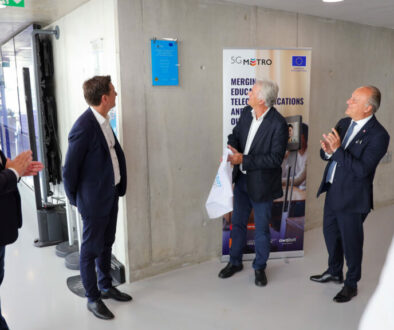
Within the 5G Metro project, Université Côte d’Azur has deployed a hybrid private 5G network at the IMREDD campus.
Unlike conventional campus connectivity, this infrastructure combines private and public mobile services on a single network, allowing the telepresence robot to benefit from reliable, low-latency connectivity while keeping sensitive communications under institutional control.
The deployment is a first in France and a pioneering initiative for European higher education. More importantly, it demonstrates how advanced connectivity can become an enabling technology for more inclusive learning environments.
Looking beyond telepresence
Although telepresence is the first application developed within 5G Metro, the project goes far beyond a single use case.
A high-performance hybrid private 5G network can support many future campus services requiring reliable, secure and low-latency connectivity, from robotics and immersive learning to smart buildings and connected research infrastructures.
By combining technological innovation with educational inclusion, 5G Metro illustrates how digital infrastructure can help universities create learning environments where students are not defined by the barriers they face, but by the opportunities they are given to succeed.