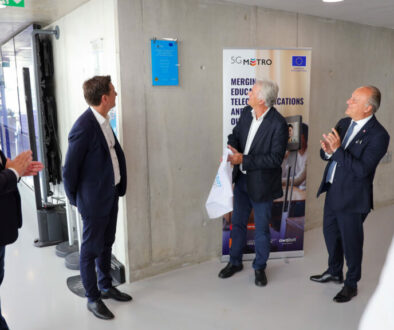
Ensuring continuous access to education for students with disabilities or long-term absences (due to severe illness or hospitalization) remains a major challenge for academic institutions. The European 5G Metro project, led by IMREDD (Université Côte d’Azur) in partnership with Orange and Awabot, addresses this very issue. This project explores the deployment of hybrid network infrastructures (private and public) to support advanced augmented telepresence uses.
While the health crisis popularized standard videoconferencing tools, the 5G Metro project demonstrates that mobile telepresence robots provide a vital technological and human breakthrough for true educational inclusion.
Student embodiment
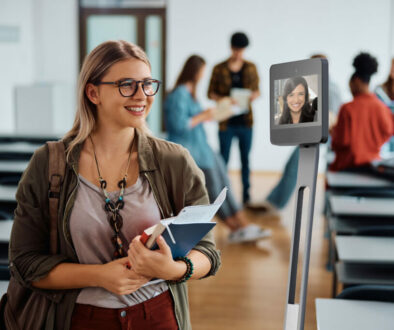
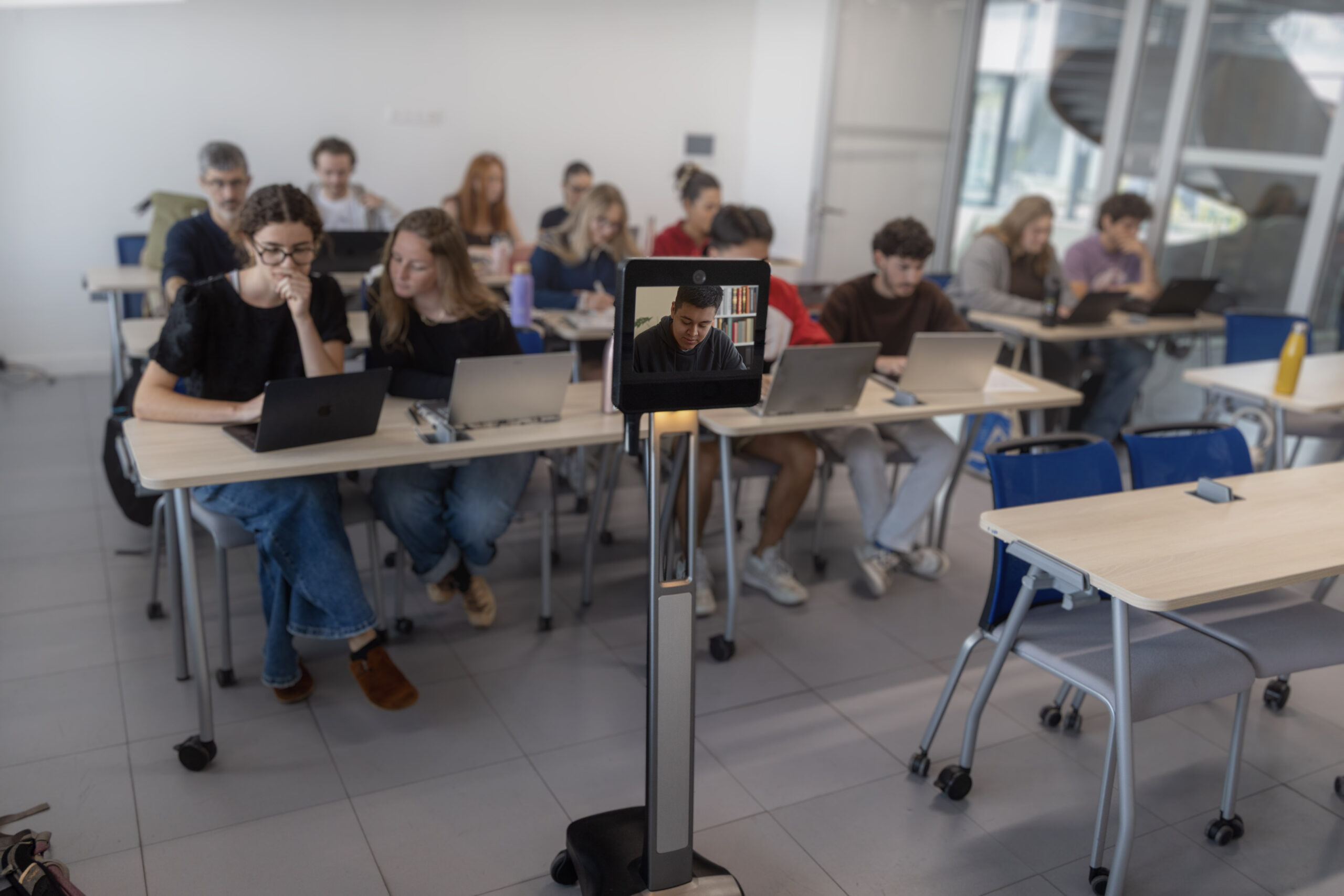
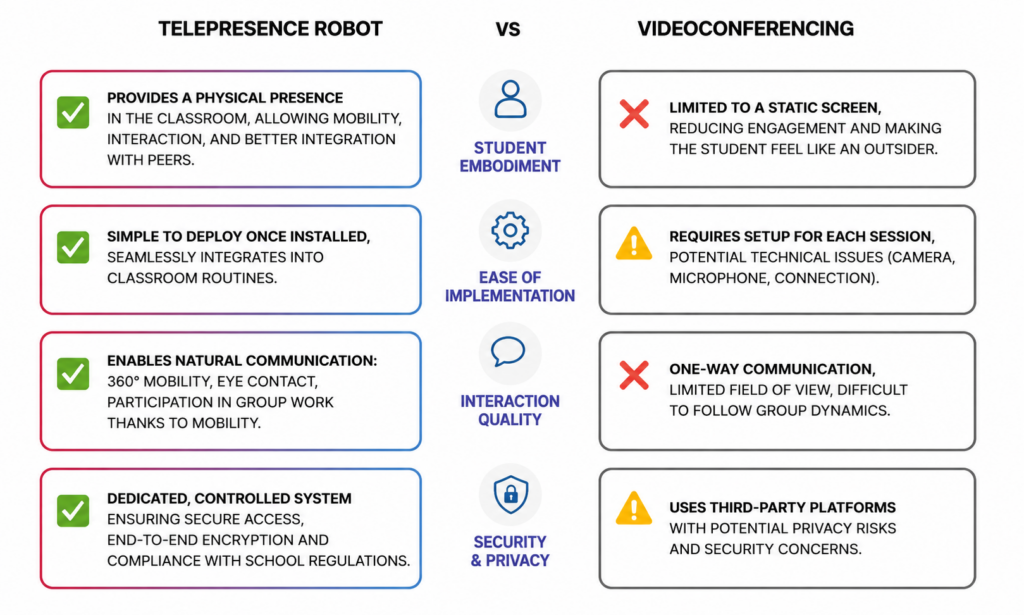
The fundamental difference lies in the concept of embodiment. A telepresence robot provides a physical presence in the classroom. Standing at approximately 1.35 meters tall, the device occupies a tangible space, can be positioned among other students or facing the teacher, and moves according to the remote student’s commands. This physical form allows the student to be perceived as an active entity, allowing mobility, interaction, and better integration with peers.
Conversely, standard videoconferencing systems are limited to a static screen fixed to a wall or placed on a desk. This two-dimensionality significantly reduces the classroom’s engagement with the remote student, often making the student feel like an outsider rather than a fully integrated member of the school community.
Interaction quality and mobility
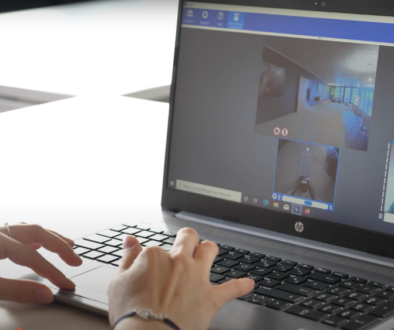
Using a robot enables natural communication by providing total freedom of movement with 360° mobility. The student can turn the camera to establish natural eye contact with their interlocutor, follow a moving teacher, or autonomously join a work group. This interactional fluidity breaks social isolation both during and between classes.
Standard videoconferencing imposes one-way communication that is highly rigid. The field of view is restricted to the fixed angle of the room’s camera. Following group dynamics becomes extremely difficult, making spontaneous interactions almost impossible.
Ease of implementation and the crucial role of 5G
The large-scale deployment of telepresence robots requires stringent network conditions: ultra-low latency for real-time remote driving, high bandwidth for HD video streaming, and seamless connection maintenance during transitions between rooms. This is where the hybrid infrastructure of the 5G Metro project shines. By leveraging the concept of network slicing, the robots’ data streams are given absolute priority, avoiding any congestion from the campus’s standard internet traffic.
While standard videoconferencing frequently suffers from micro-outages due to overloaded local Wi-Fi networks or requires frequent human intervention to adjust the hardware, combining the Awabot robot with Orange’s 5G technology makes the digital tool fluid, stable, and completely transparent for the user.
Security, privacy, and long-term inclusion
Educational institutions demand rigorous data protection for minors and university students. Telepresence robots rely on a proprietary, secure software ecosystem that provides end-to-end encryption of all feeds and strict access control. In contrast, mainstream videoconferencing tools frequently face scrutiny regarding data sovereignty and privacy compliance.
Building on national initiatives like the TED-i program by the French Ministry of National Education (which deployed over 1,500 robots via Awabot), the 5G Metro project demonstrates that sustainable university inclusion is fully achievable today. Trials conducted at IMREDD and Polytech Sophia Antipolis confirm that the robot positively redefines the daily lives of homebound students, allowing them to pursue their studies without severing the social ties that are essential to their academic success.