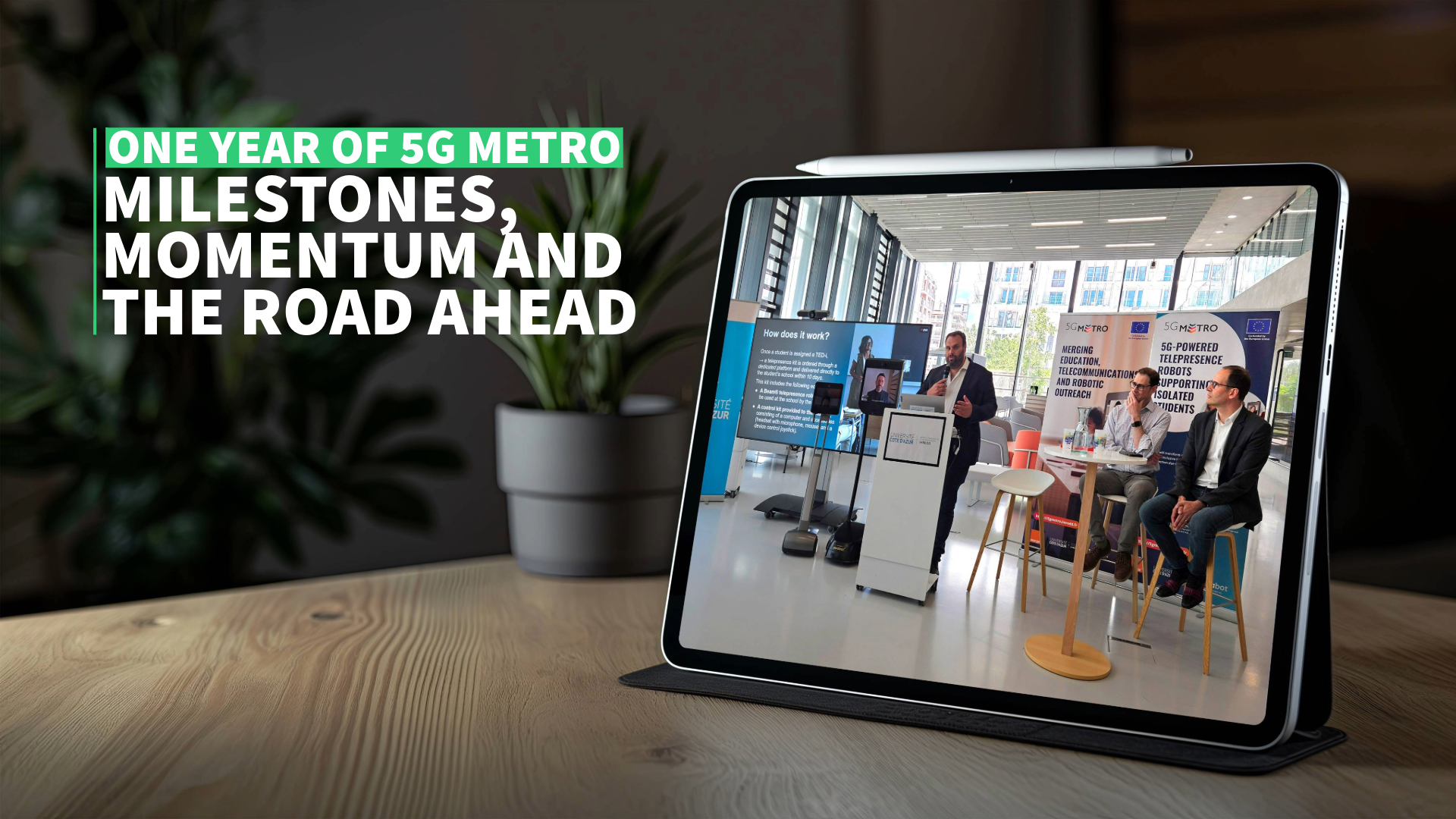
Launched in December 2024, the 5G Metro project has completed its first year of implementation, marking an important milestone in its ambition to build inclusive, human-centered digital learning environments. Co-led by Orange, Awabot, and IMREDD at Université Côte d’Azur, the project brings together cutting-edge telecommunications, robotics, and academic research to address educational inequality and social isolation through 5G-powered telepresence.
A Year of Solid Foundations
Over the past twelve months, 5G Metro has successfully delivered all milestones set for the first implementation phase. The project team completed the design and validation of a hybrid 5G Standalone (SA) infrastructure, deploying one of the first integrated systems in Europe dedicated to inclusive education and robotics experimentation. The Indoor Mobile Coverage system, built on Nokia’s ASIR distributed antenna technology, was completed in November 2025 and will, from mid‑December, provide full public and private 5G connectivity throughout the entire IMREDD building.
Procurement processes were carried out in full compliance with EU regulations, and the technical installation was validated through collaborative work between Orange’s engineering teams, IMREDD’s digital infrastructure experts, and Awabot’s specialists in telepresence and robotics. These efforts have ensured a robust and scalable system that is interoperable, secure, and aligned with future 5G standards.
Early Experiments and Outreach
In May 2025, the project held its first public demonstration event at IMREDD, showcasing the potential of 5G telepresence robots to policymakers, educators, and students. The event featured a hybrid format (including a live intervention by a Ministry of Education representative via robot) and served as a launchpad for a coordinated outreach campaign.
Eight in-depth editorial articles have been published on the 5G Metro website, complemented by cross-platform sharing on LinkedIn and Bluesky. These articles unpack complex topics such as network slicing, hybrid 5G networks, and the differences between telepresence and traditional videoconferencing. Read collectively over 90 times, they reflect an exemplary collaboration in knowledge transfer between the project’s industrial and academic partners.
From Design to Deployment
As of December 2025, the infrastructure is fully deployed and ready for real-world use. The next phase will see the launch of pilot activities involving connected robots, IoT systems, and edge computing applications for education and healthcare. These trials will measure the impact of 5G telepresence on accessibility, learning outcomes, and user experience, particularly for students facing mobility or health constraints.
At the same time, a new Augmented and Virtual Reality (AR/VR) program will explore immersive learning environments and networked perception systems, expanding the project’s reach to smart mobility and safety monitoring.
Toward a European Reference
5G Metro continues to position itself as a replicable European model. Through the Ulysseus Alliance and participation in events like the Smart City Expo World Congress in Barcelona, the consortium actively shares results and methodologies with other universities and innovation ecosystems. This reinforces the project’s ambition to move beyond a single site and toward a transnational standard for responsible, inclusive digital transformation.
What’s Next?
Looking ahead, the second year of 5G Metro will focus on:
- Activating and testing real-world use cases in education;
- Launching the AR/VR initiative and co-developing immersive prototypes;
- Finalizing the project’s replication model for multi-campus adoption;
- Deepening collaboration with policymakers to align with EU digital inclusion strategies.
As it enters its second year, 5G Metro stands as a concrete example of how advanced technology can be combined with human values to make education more inclusive, connected, and future-ready.